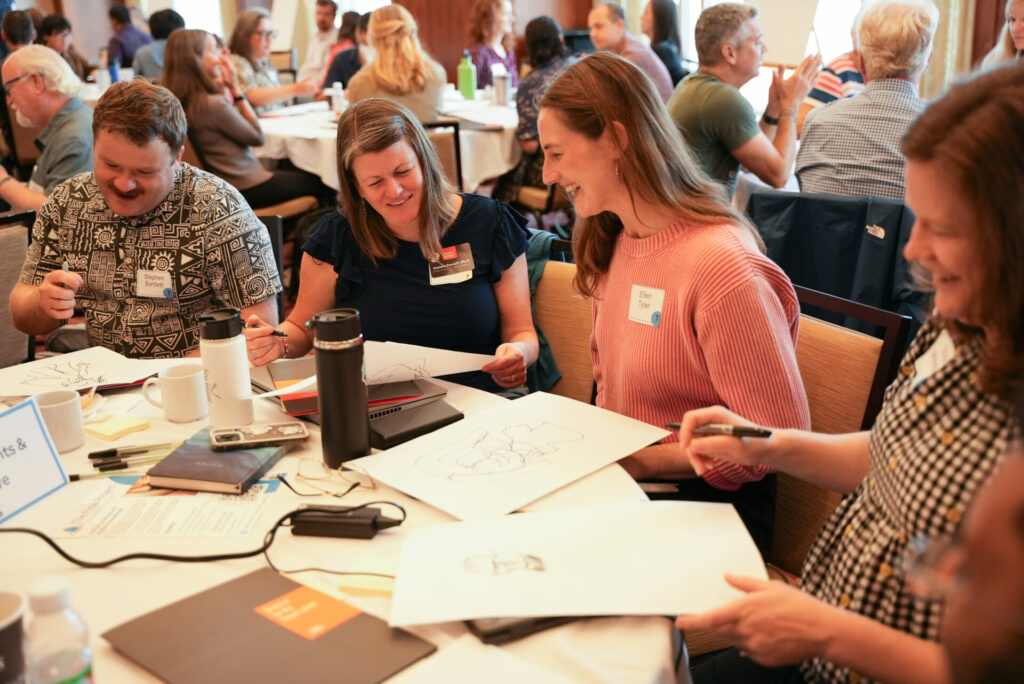
The Water Partnership Workshop gathered in September as part of an overall effort to turn scientific inquiry directly toward the priorities and needs of others, an approach known as community-engaged research. (Photo by Bonnie Willison / ASC)
By Alison Mikulyuk, Water@UW–Madison Research Program Coordinator, and Sarah Peterson, Community Engagement and Professional Development Manager
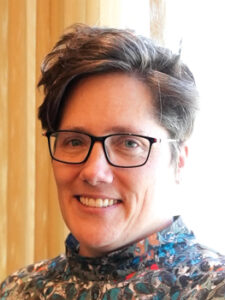
Alison Mikulyuk, Water@UW–Madison Research Program Coordinator (Photo by Bonnie Willison / ASC)
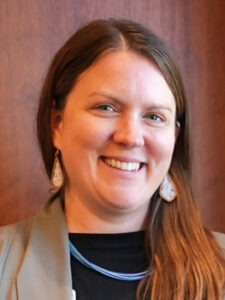
Sarah Peterson, Community Engagement and Professional Development Manager (Photo by Bonnie Willison / ASC)
Last fall, more than 70 water professionals, researchers, and community leaders gathered on the University of Wisconsin–Madison campus for the first-ever Water Partnership Workshop, hosted by Water@UW–Madison and Wisconsin Sea Grant. The energy in the room was apparent: conversations buzzed and ideas flowed freely as participants leaned into the opportunity to shape Wisconsin’s water future.
The lively discussion revolved around one question: What should we research — together — next?
This type of collaboration is a reflection of the growing desire to turn scientific inquiry directly toward the priorities and needs of others. Known as community-engaged research (CER), this approach centers community voices and fosters collaboration in science.
CER requires us to evaluate whether science is asking the right questions. Are research projects grounded in concerns and priorities shared by the community? Are researchers answering them in ways that are fair and useful? When done well, CER also helps build trust in science and the scientific process, empowers communities to take action and build strength, and can help democratize knowledge production so that more people have access and stand to benefit.
A growing number of scientists are inspired to participate in CER; however, many don’t know where to begin. In our roles at the Aquatic Sciences Center, we often hear the same question from scientists: How do I get started in a collaborative partnership with a community group?
Our attempts to answer that question led us to organize the Water Partnership workshop in September.
Matchmaking researchers with community partners
Designing the workshop took several months and started with brainstorming about how we as coordinators could help build relationships between campus researchers and community partners. Early on, we decided to offer a full-day workshop structured around a set of topics that scientists and community members wanted to tackle together. Our goal was to spark new connections, foster collaboration, and provide a space where community-engaged water research projects could begin to take shape.
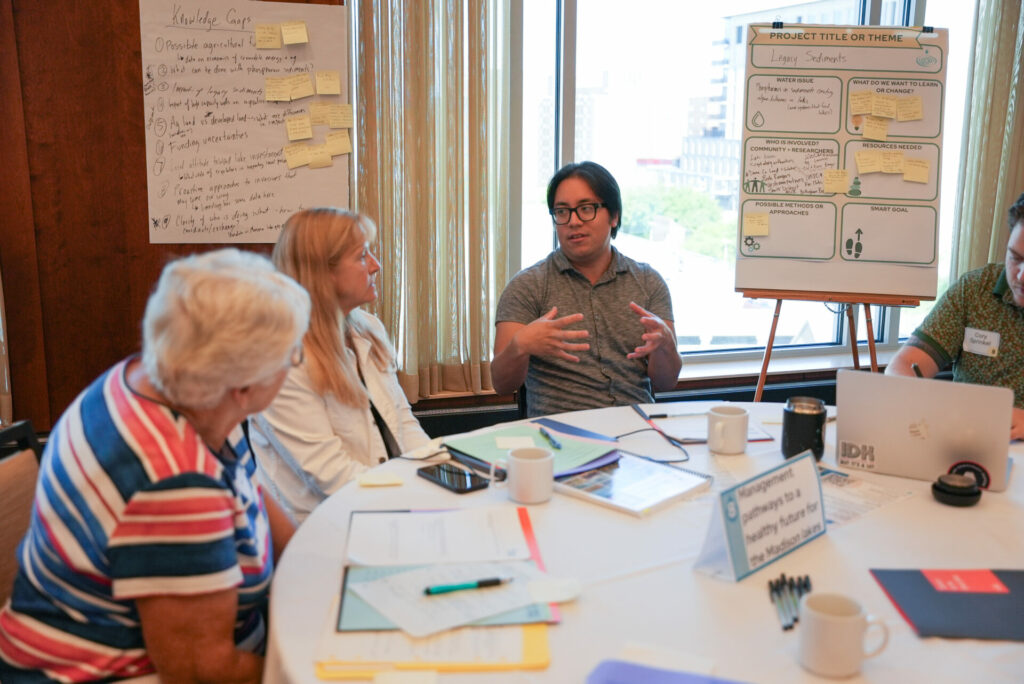
Water professionals and community members discuss phosphorus in Madison-area lakes. (Photo by Bonnie Willison / ASC)
We reached out to over 40 contacts within Wisconsin’s diverse water network, who then reached out across their networks in turn. Participants were almost always excited about the opportunity to connect. After a series of one-on-one meetings with community representatives, we identified a collection of eight organizations eager to participate, each with their own unique concerns related to water.
Behind the scenes, we began to match researcher expertise with the questions posed by community guests. As we recruited and aligned participants, we found ourselves creating a topic-specific seating chart that resembled something you’d see at a wedding reception. We aligned the participants on topic and interest, then balanced the groups to include experts and community members from a range of career stages and disciplines.
The multigenerational, multidisciplinary groups that emerged set the stage for what we hoped would be a set of really interesting and productive conversations.
Moving at the speed of trust
The eight groups that came together on September 11 arrived with a wide range of water topics that mattered to them.
- Representatives from the Wisconsin Farmers Union discussed agricultural trade-offs between organic and conventional practices.
- The Coon Creek Community Watershed Council explored ways of rethinking flood management to address aging dams throughout the watershed.
- Wisconsin EcoLatinos discussed culturally relevant communication about environmental contaminants in Latino communities.
- Representatives from the Black Earth Creek Watershed Association explored the impact of neonicotinoid pesticides on aquatic invertebrates in trout streams.
- Southern Wisconsin Trout Unlimited discussed the relationship between urban stormwater management and trout streams.
- A member of the Lac du Flambeau Band of Lake Superior Chippewa Indians spoke about tribal water rights and imagining ecology beyond a Western scientific framework.
- Staff from the Great Lakes Inter-Tribal Epidemiology Center engaged in a discussion on emerging contaminants and cumulative impacts to tribal communities across Wisconsin.
- Volunteers with two Madison-based lake associations spoke about phosphorus contamination and future management pathways.
Over the course of six hours, the workshop revealed some cross-cutting challenges. One theme that surfaced was that scientific data and tools are often too complex for practical use. There was shared consensus that researchers must prioritize translating research into simple, actionable decision-support tools.
Another theme spoke to how essential trust is for developing effective solutions, requiring two-way communication and the involvement of trusted community messengers. It highlighted how academic research operates at a certain pace, often driven by grant cycles, project management milestones or tenure review timelines. However, CER is not only in the hands of researchers, so it must always strive to move at what we’ve come to call the “speed of trust.”
Future collaborations
It’s our hope that we helped forge lasting connections that day. While we don’t know yet what will come of the projects and ideas that were generated, we know we’re learning more about a model by which to facilitate trust and exchange.
We hope that the Water Partnership Workshop was more than a one-day event — we envision it as a catalyst, demonstrating the power of bringing many voices together around shared water interests. We hope it helped lay groundwork for future collaborations that are community-initiated, interdisciplinary, and action-oriented.
We are already planning our next collaborative event, refining the model using feedback we received from participants. We strongly believe that this is what water research should look like: people coming together, listening deeply, honoring community agency, and building something better, together. If you’re interested, reach out to water@mailplus.wisc.edu to join us.
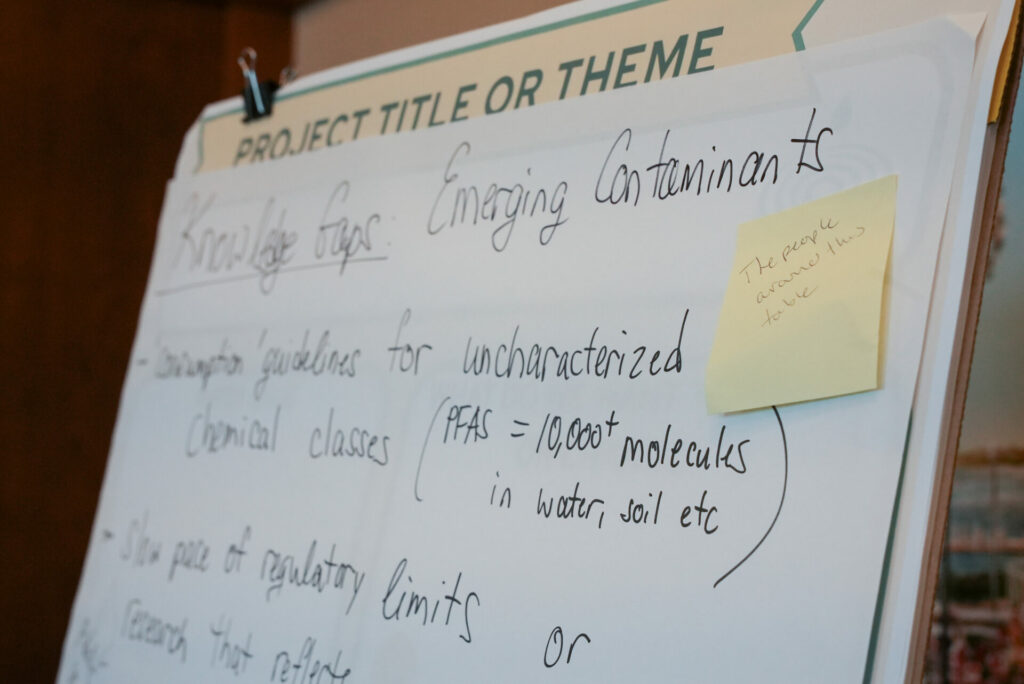
Emerging contaminants were just one of the topics discussed at the workshop. (Photo by Bonnie Willison / ASC)