

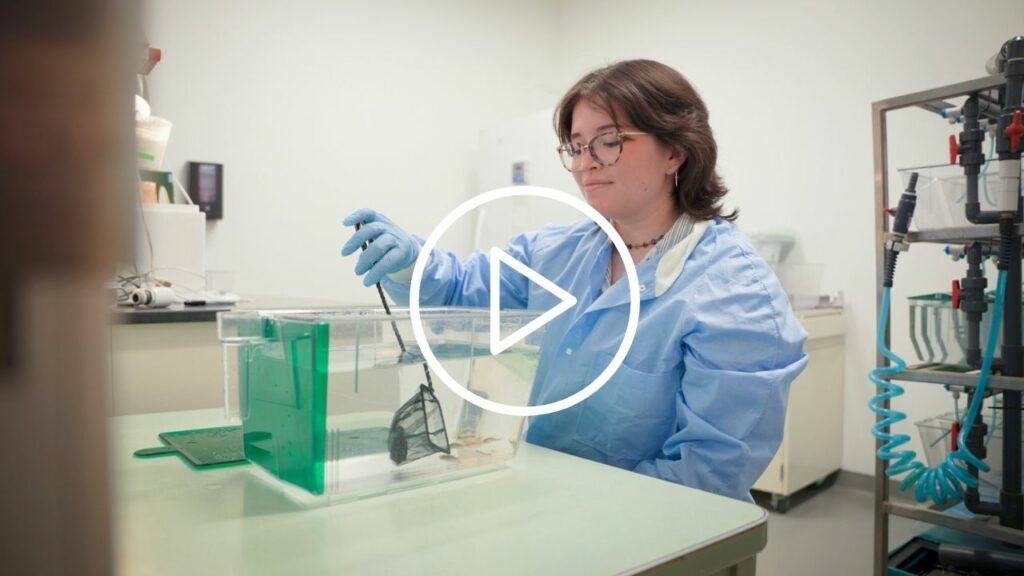
Watch “How do PFAS affect Wisconsin’s fish?” (Video by Bonnie Willison / ASC)
In order to become big fish, baby fish face seemingly impossible odds. They evade predators, find food, and fend off disease — all while being smaller than the size of a fingernail. But what if contaminants in the water affect their ability to respond to those challenges and survive?
With funding from Wisconsin Sea Grant, University of Wisconsin–La Crosse Professor Tisha King-Heiden is studying how per- and polyfluoroalkyl substances, or PFAS, impact the nervous and immune systems of young fish. PFAS are a family of chemicals found in non-stick and waterproof household products, from food packaging to dental floss. They’re widespread in lakes and rivers across Wisconsin.
“What I’m interested in is how exposure to environmental contaminants during early stages of embryonic development can lead to adverse health effects later on in life,” said King-Heiden.
Her work on the project is personal. King-Heiden lives on French Island in Campbell, Wisconsin, where the groundwater is contaminated with PFAS.
“It hit home pretty hard. I’ve been on bottled water now for going on five years,” she said. “So I just wanted to try to contribute a little bit more to understanding what the risks are and what they aren’t, because there’s still quite a few unknowns.”
New PFAS, new fish
With over 7,000 types of PFAS, King-Heiden is zeroing in on three newer chemicals: PFHxS, PFUNdA, and PFNA. Not much is known about how they affect fish, as past studies have primarily focused on older, “legacy” PFAS that are no longer used but remain in the environment.
”The vast majority of information we have is on PFOA and PFOS. So those are […] the original PFAS chemicals,” she said.
PFHxS, PFUNdA, and PFNA have slightly different chemical structures than the legacy PFAS, which may affect how they accumulate in and affect fish.
Another novel aspect of King-Heiden’s project is the type of fish she’s studying: fathead minnow, walleye, and sturgeon. Many PFAS studies use zebrafish, a popular lab species from southern Asia.
“I wanted to try something different and start working with some other prevalent species that are more ecologically and culturally relevant to people living in Wisconsin,” she said.
Measuring tail flicks and body bends
To evaluate the effects of PFAS on fish, King-Heiden and her team are collecting data on hatching success, growth, and immune system responses. They’ve also developed a series of behavioral tests to gauge how the nervous system develops.
The first test? Watching fish embryos for tail flicks.
“It’s the same thing that humans feel when they can start to feel the fetus moving,” said King-Heiden. “If they are flicking their tails too much, or if they’re not flicking them enough, it can give us an idea of how PFAS is impacting that nervous system development.”
After the fish hatch, the team then measures how well they can respond to stimuli. King-Heiden explained that during this time, fish develop neurons along their body that help them sense movement in the water. And when they do detect movement — a lurking predator, perhaps — the fish bends into the shape of “C” and swims away. It’s called a C-start response.
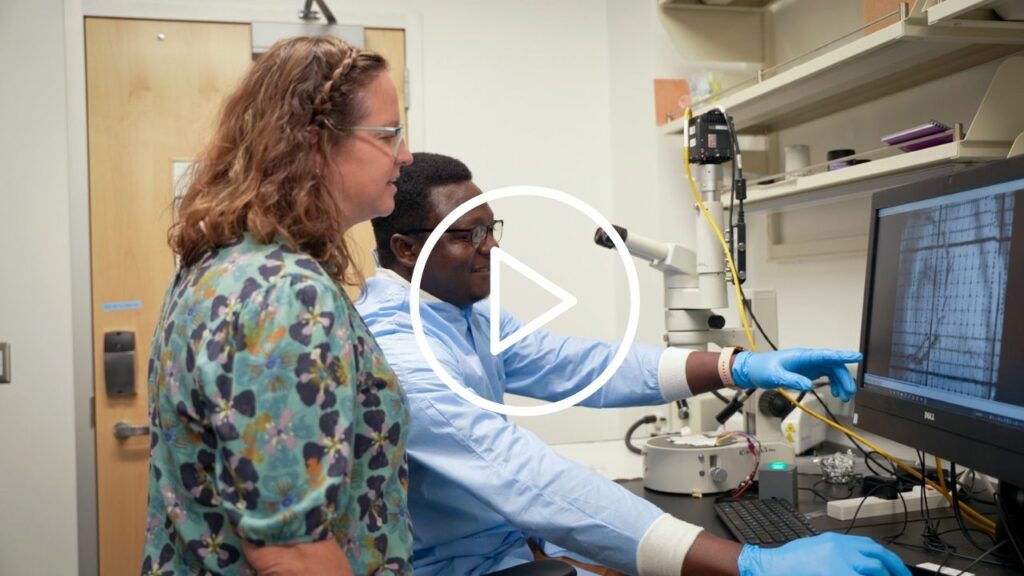
Watch “The C-start: Sea Grant funded research.” (Video by Bonnie Willison / ASC)
“It’s an autonomic reflex, like the knee-jerk reflex,” she said.
Using a high-speed camera, the team measures how long it takes for a fish to respond to a vibration sent through the water. The longer the response time, the more likely the neurons are damaged.
The final behavioral test raises the stakes. Instead of contending with vibrations, a baby fish is placed in a container with a hungry adult fish.
“We give them a certain amount of time and see if the fish can actually escape that predator,” King-Heiden said. Cumulatively, the tests can indicate how the nervous system is developing and how baby fish might survive in the wild.
Protecting wild fish and people
While PFAS concentrations in lakes and rivers may not be high enough to kill baby fish, they could make them more susceptible to predation and disease. King-Heiden said that could spell trouble for wild fish populations, especially if they’re dealing with other issues, like invasive species.
“If you add other environmental contaminants and stressors like disease to that mix, you can exacerbate the problem,” she said.
Human health is also a concern, as people catch and eat fish from contaminated water. Understanding if and how the new PFAS accumulate in tissues of fish can help set consumption advisories that keep people safe. King-Heiden is also developing a communication campaign to engage local communities around PFAS, fish, and human health.
“We can try to help explain why it’s important for us to spend the money to clean up PFAS, to spend the money to support the research that’s going to find the most cost-effective way of cleaning up our drinking water for both human health as well as our wildlife,” she said.
***
The University of Wisconsin Aquatic Sciences Center administers Wisconsin Sea Grant, the Wisconsin Water Resources Institute, and Water@UW–Madison. The center supports multidisciplinary research, education, and outreach for the protection and sustainable use of Wisconsin’s water resources. Wisconsin Sea Grant is one of 34 Sea Grant programs supported by the National Oceanic and Atmospheric Administration in coastal and Great Lakes states that encourage the wise stewardship of marine resources through research, education, outreach, and technology transfer.