
It hadn’t been a successful morning for the Great Lakes Eagle Health team.
Traveling by boat, truck, and foot, the team was searching for active eagle nests along the Wisconsin River in Nekoosa, Wisconsin. Tree one was a dud, and tree two, a heartbreaker. Dan Goltz, one of the team’s climbers and a wildlife biologist with the Wisconsin Department of Natural Resources, scaled a 70-foot tree only to be met with a gentle breeze blowing through an empty nest.
“It’s always a nice view,” he sighed, coiling his rope for the next climb.
The team, however, had reason to be optimistic about tree number three, located on the grounds of a paper products factory on the river.
For one, it was streaked with whitewash, or eagle poop. Loathe to defecate inside their nests, baby eagles poop off the sides, spraying the ground with what looks like white paint. Fresh whitewash usually indicates an active nest.
The second promising sign was that the tree was a white pine — Goltz’s favorite. Unlike cottonwoods, whose deeply furrowed bark could chip off under the pressure of spurred boots, white pines are smooth and offer stability. Goltz’s footholds would be more secure, and his climb, safer. Snapping on a hot pink helmet, he spiked his shoes into the trunk and began to haul himself upward.
And then there was what was happening above Goltz’s head. A bald eagle, clear against the high-noon sky, flew into view and began to circle and chirp. A second soon joined to voice its displeasure at the man approaching the nest.
“That’s a great sign when you hear the bird chirping at you like that,” said Brian Dhuey, WDNR research technician, peering through the trees. “It means there’s something to protect.”
The presence of the eagles energized the team on the ground. Lindsey Long, a WDNR wildlife veterinarian, kneeled on a blue tarp and began to unpack her sampling equipment: tubes, syringes, glass slides, a small machine that repels mosquitoes. Two volunteers huddled closer and listened as she explained protocol for taking blood. Dhuey shuffled among the dry leaves.
Now, they waited. Necks craned toward the sky, the team watched Goltz climb, hoping for news of a bird.
What eagles can tell us
The Great Lakes Eagle Health Project has tracked contaminant levels in bald eagles across Wisconsin since 1990. Currently funded by the National Oceanic and Atmospheric Administration (NOAA) and U.S. Geological Survey, the project brings together federal, state, tribal, and academic partners to test eagles for a variety of pollutants, like heavy metals and PCBs, and investigate how they’re affecting eagle health.
In 2023, Wisconsin Sea Grant’s emerging contaminants specialist Gavin Dehnert joined the project to investigate a new problem: per- and polyfluoroalkyl substances, or PFAS.
Dubbed “forever chemicals,” PFAS don’t break down easily and are found in common household products like non-stick pans and water-repellant clothing. They’re harmful to human health and have been found in high concentrations in drinking water in communities across Wisconsin, like French Island and Marinette.
Dehnert, who has studied PFAS in maple syrup, wild rice, and fish, said eagles are what’s known as a “sentinel species,” organisms that can alert humans to environmental toxins — like a canary in a coal mine. Due to their diet, bald eagles are particularly good indicators of how much PFAS are in the environment.
“They eat a lot of the same foods that we do,” said Dehnert, like fish and deer. “And because they also eat both aquatic and terrestrial food sources […], they give us a really good idea of how much contamination is in the area.”
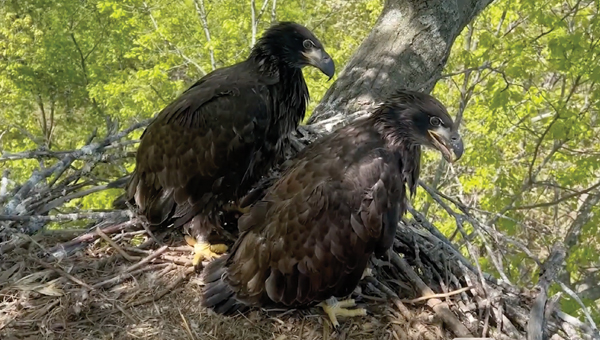
Eaglets in the nest. (Photo by Matt Stuber)
The team exclusively takes blood samples from baby eagles, called nestlings, that are younger than 12 weeks old. Because they cannot fly, the nestlings’ main exposure to PFAS is from the food their parents bring. This means that their blood samples provide clues to how contaminants are moving through and accumulating in the food web.
Each year, the team chooses different sampling sites. In May of 2025, they focused on the Wisconsin River, spending two weeks sampling eagles from Prairie du Chien to Minocqua.
“Because the Wisconsin River is so long and vast, it gives us a really good gradient of how these PFAS levels are changing,” said Dehnert. The team expects levels to be higher in the middle section of the river due to the presence of industries that have historically used PFAS.
In addition to measuring PFAS levels, Dehnert and Emily Cornelius Ruhs, an ecoimmunologist and postdoctoral researcher at the Field Museum, are studying how the contaminants affect eagle health, specifically their physical bodies and immune function. Do PFAS weaken eagles’ ability to fight off illness? Do they impact hormone levels? How are eagles growing and developing?
“We don’t know a lot about it or how it impacts wildlife,” said Cornelius Ruhs.
But a lot of information can be gleaned from a blood sample.
Landing the bird
The news was good. Secured to the tree with ropes, Goltz had peered across the eagles’ platform of sticks and declared there was not one, but two nestlings in tree number three. The task now was to safely transport the birds through the canopy to the team below.
Long mused at the feat from her spot on the blue tarp.
“The climber has to get that in a bag by himself,” she said. “It’s pretty amazing, the skillset that they have. Both of our climbers are also really, really, good at bird handling and are really conscientious.”
The climbers use what’s essentially a chicken hook — a tripod leg with a hook on the end — to coax the eagles toward their bag. Goltz’s hook had green glitter on it, which, he deadpanned, mesmerized the birds.
A joke, perhaps, but sometimes the rally cap prevails. Goltz’s bag lowered into view, and Dhuey swiftly claimed it.
Bird in tow, Dhuey walked back over to the team. He weighed the bird, still in its drawstring pouch, and knelt next to Long. With blue surgical gloves on their hands, they peeled back the bag to reveal the fluffy bundle they’d been chasing all morning. Dhuey held the bird as Long made final preparations for the blood draw.
“Want to see a baby dragon?”
Chocolate brown with sulfurous yellow feet, the nestling was no less striking than its parents. Its talons were curved and black, and under Dhuey’s strategic grip, they looked positively reptilian. The eaglet looked around at the team, a breeze riffling its feathers.
Long was ready. She helped Dhuey lay the nestling on its back and covered its head to keep it calm. One hand holding the feet, one hand unfurling the wing, Dhuey secured the bird. Long grabbed the syringe. The choreography between them was familiar and swift, two researchers practiced in the art of data collection.
Long crouched over the wing. Earlier, she said taking blood from an eagle is like taking blood from a human. Cold temperatures and dehydration can make the draw harder.
“Sometimes we have to do a little manipulation,” said Long, “just like if you’re at the hospital and they’re like, can you pump? Or, you need to move your arm a certain way or make a shift.”
On this unusually warm day in early May, the eagle wasn’t cold or dehydrated. Dark red began to spiral through a thin tube into the syringe.
Keeping eagles in the sky
Once collected, the blood samples are smeared onto slides and prepared for further testing. That’s where ecoimmunologist Cornelius Ruhs comes in. Her job is to decode what the blood says about the nestlings’ health.
“The blood sample is used for many things. The first one is a white blood cell count,” she said. “And that’s pretty much the same as what you would get at a doctor’s office, like a CBC or blood panel.”
Cornelius Ruhs also measures total antibody levels in the bird’s blood, levels of two different thyroid hormones, and corticosterone, a stress hormone. Additionally, the team is running a new test that’s only been done on humans and other primates. Known as an “ex vivo blood challenge,” the test mimics bacterial and viral infections in a tube containing live blood from the bird. The blood can then be sent off and analyzed for how it responded to the challenges.
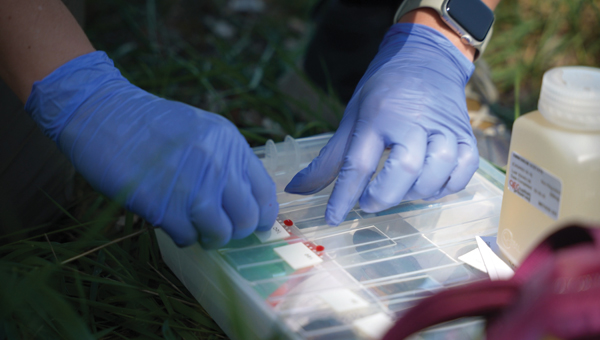
Emily Cornelius Ruhs smears blood samples onto slides. (Photo by Bonnie Willison / ASC)
All these data points tell a story about how well a baby eagle can fight off infection, like bird flu. The hypothesis is that “being exposed to high levels of PFAS might cause [eagles] to not respond as well or mount a response to a viral or a bacterial challenge,” said Cornelius Ruhs.
And that’s a concern for an iconic bird that was, in the 1960s, nearly extinct. “Bald eagles have been hit so hard by contaminants in the past, like DDT,” said Cornelius Ruhs.
Prior to being banned in 1972, DDT was widely used to kill mosquitoes, but it also weakened the eggshells of birds like bald eagles that ate contaminated fish. The eggs cracked under the weight of the incubating birds, causing reproduction rates to fall.
Long-term studies like the Great Lakes Eagle Health Project, however, can sound the alarm before something like that happens again. Bald eagles are beloved birds, and many folks want to continue seeing them thrive.
“This project is really special, I think, to all of us, not just because we get along so well and we all enjoy working with each other, but just because of the uniqueness to it,” said Cornelius Ruhs. “I don’t think a lot of people get to work with these large, majestic animals.”
A good day’s work
In under 10 minutes, the team had taken blood and measured beak, wings, and feet. Dhuey then snapped a lightweight metal band to the eagle’s ankle, a way to track and identify the bird. The cuff glinted like new jewelry above the outsized yellow feet.
Long and Dhuey then gently folded the bag over the bird to be ferried back up the tree as quickly as it came down.
The experience at tree number three went unrivaled. After lunch — the team had gotten ice cream, they claimed, to ensure their good fortune — they found an unoccupied nest in a cranberry bog and ended the day with another eagle-less climb up a tall white pine near the river.
It was clear that camaraderie kept the team going, even during the busts. They work two weeks together every year, crammed in aluminum boats, fighting heat and mosquitoes, processing blood samples in hotel parking lots. Several team members said they spend the weeks following field season looking out of car windows, looking for nests. They can’t help it.
This spring, it’s the Mississippi River.
“Every day is just getting us back to eagle sampling field season,” said Cornelius Ruhs.
***
The University of Wisconsin Aquatic Sciences Center administers Wisconsin Sea Grant, the Wisconsin Water Resources Institute, and Water@UW–Madison. The center supports multidisciplinary research, education, and outreach for the protection and sustainable use of Wisconsin’s water resources. Wisconsin Sea Grant is one of 34 Sea Grant programs supported by the National Oceanic and Atmospheric Administration in coastal and Great Lakes states that encourage the wise stewardship of marine resources through research, education, outreach, and technology transfer.