Murky. Soft. Squishy. Punky.
This time of year, there’s a lot of names bandied about to reference the lakes and waterways of Wisconsin and the not-so-frozen layers covering them, but eventually they lead to one term we can all understand.
Thin ice.
For winter anglers, ice thickness and ice safety are ever-present topics of conversation: at the bait shop, in the shanty, and at everyone’s favorite fish frys and watering holes.
Unfortunately, recent changes in ice cover, not just on the Great Lakes bordering Wisconsin but throughout the state, are creating more hazards for ice anglers. One recent study from the National Oceanic and Atmospheric Administration (NOAA) noted the Great Lakes have experienced a 70% decrease in average annual maximum ice cover between 1973 and 2018. News stories about rescuing anglers from large ice floes in Lakes Michigan and Superior have brought the question of thin or unsafe ice cover more into the public eye. It seems today that murky, soft, squishy ice is not only a late-winter or early-spring focus for anglers but now a season-long concern.
So, what can ice anglers do differently to stay safe? Traditionally, providing information on current ice conditions is as slippery an endeavor as trying to reach your tip-ups on a frozen bay without ice cleats. Most state agencies like the Wisconsin Department of Natural Resources do not provide ice forecasts but rather stick to the mantra that “no ice is 100% safe,” an understandable stance given the vagaries in temperature, wind, and water. One recent stretch this February saw state temperatures swing from 50-60 degrees one day to mid-20’s the next.
Thankfully getting answers to this tricky question has not deterred a team of Wisconsin Sea Grant researchers from looking into ice safety and how to work with the ice angling community, Wisconsin DNR, and other partners. Their goal is not only to improve the information available to ice anglers but also understand how they seek out trusted sources of data and respond to the ice conditions they’re seeing.
Nan Li is one of the lead researchers for the team. An associate professor in Life Sciences Communication at UW–Madison, Li teaches undergraduate and graduate courses in visual communication and risk communication. Her research examines how visual communication shapes the ways people understand and engage with science.
“As ice conditions across the Great Lakes become more unpredictable, we need to move beyond just warning people about risks,” said Li. “The goal is to help anglers better understand what’s changing and develop evidence-based strategies to make safer decisions in real time. This project is really about staying ahead of the problem, not just reacting to it.”
Bret Shaw is Li’s co-lead on the project and also hails from UW–Madison. Like Li, Shaw is a professor with the Department of Life Sciences Communication; he’s also an environmental communications specialist for the Division of Extension.
“This is the first empirical study on how Great Lakes ice anglers perceive emerging risks from warmer winters,” said Shaw. “We hope this collaborative effort will have a practical impact, that our findings will inform the development of impactful and authentic safety-focused messages for ice anglers.”
The two are joined by Tim Campbell and Titus Seilheimer, two long-time members of Sea Grant’s Extension team. Both Campbell and Seilheimer have extensive experience working with anglers all around Wisconsin and the Great Lakes, helping ensure that the materials developed through this project speak directly to the needs of the communities most affected.
“This approach to data collection is how we can help people and communities make the best science-based decisions using the best information possible,” said Campbell.
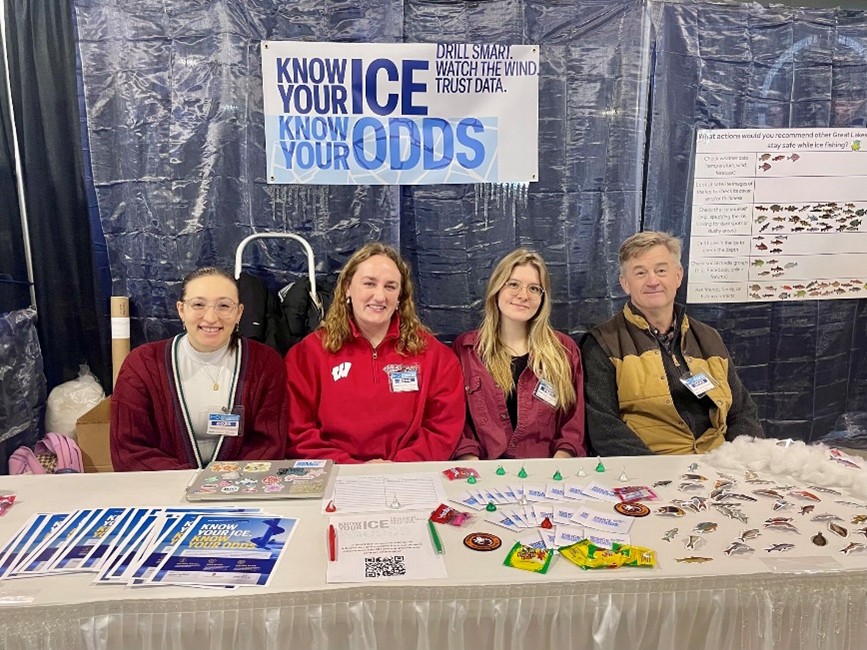
Researcher Brett Shaw (far right) tables a booth with a portion of the student research team at the Ice Fishing Expo last December. (Submitted photo)
First challenge: reaching out
The first big question Li said they had to tackle was: Where can you find ice anglers to interview and survey? At least in enough numbers that will provide meaningful results?
“We thought there’d be a list, but nobody had a list,” said Li. She said they also checked in with ice fishing equipment vendors, but for obvious business reasons they were reluctant to share their customer data.
They started close to home, focusing on ice anglers around Green Bay, but Li said “It didn’t feel like we were getting enough people” responding to their initial outreach, so they broadened their search to the western Great Lake states – Minnesota, the Upper Peninsula of Michigan, and the rest of Wisconsin. To recruit participants, the researchers used targeted Facebook ads and posted calls for participation in social media groups and online forums frequented by ice anglers.
In the end ice anglers were very cooperative and the team was able to cast a wide net, surveying more than 300 individuals, looking into their current perceptions regarding ice safety and learning not only what they do to keep safe but also identifying the information sources that anglers trust.
Surveys and interviews confirm increase in ice safety concerns
Some of the demographic findings from the survey were not surprising to the researchers. Most respondents were experienced ice anglers, with 68 percent ice fishing for more than 20 years and nearly two-thirds over the age of 44.
The respondents also confirmed the need for the team’s study. Seventy-one percent agreed ice conditions have become increasingly unsafe the past two years, with people most concerned about falling through the ice in deep water, or their vehicle falling through the ice. Some shared personal accounts of accidents and attributed them to unsafe practices.
“There were some biases in the sample group, which also wasn’t surprising,” said Li. “No respondent we selected said they had little or no confidence in their own ability to stay safe on the ice, yet 43 percent of the respondents said they had little or no confidence in others’ ability to stay safe on the ice.”
As far as trusted information sources, the preferred choice for ice anglers based on the survey results are weather data and checking the ice themselves, though 59 percent of respondents check social media groups to decide whether it is safe to go out on the ice.
Additionally, the team conducted in-person interviews with a smaller sample, looking to dig deeper into risk perceptions in Wisconsin.
Li noted, “Across all interviews, anglers consistently described the ice now as highly unpredictable.” Green Bay is one example, added Li, with many respondents citing the winters of 2022 and 2023 – right before the interviews were conducted – as the “worst in decades due to minimal freeze-up, strong currents, and widespread open water.”
Li added that anglers have changed their activities due to concerns of soft ice. “Many described shifting to walking or cautious [utility vehicle] use because driving vehicles is no longer safe,” said Li. “And several highlighted the role of social dynamics, such as inexperienced anglers, risky guide practices, and pressure to follow crowds, in contributing to close calls.”
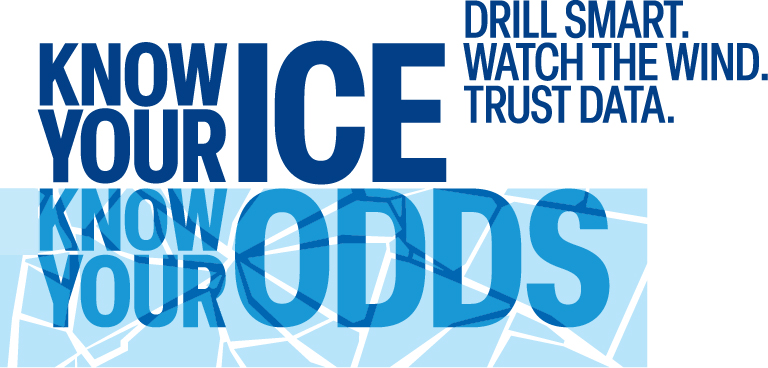
Ice angler safety campaign ad.
Turning results into action
With results in hand, the team turned their attention towards practical applications: taking their project into the public realm via a series of outreach materials and finding ways to share them with the ice fishing community.
“One piece is a campaign logo – ‘Know Your Ice, Know Your Odds’ – that will appear on banners, swag items, flyers, social media, and other outreach materials,” said Li. “The design is intentionally neutral and inclusive to ensure it resonates with a wide range of anglers. The messaging focuses on encouraging positive behavioral changes associated with higher risk awareness, rather than trying to scare people away from ice fishing – an approach that is unlikely to be effective given the biases we observed.”
The group also launched a mini campaign at the end of 2025, which included an advertisement published in the 2025 annual issue of “Ice Fishing” magazine and tabling a booth at the Wisconsin Ice Fishing Expo in Oshkosh.
Li’s graduate and undergraduate students also contributed to the design effort, which was ultimately finalized by a professional marketing agency. As part of a service-learning partnership, students in Li’s Visualizing Science and Technology course developed early drafts of the outreach materials, producing a range of concepts including infographics, maps, and even a comic strip.
For social media outreach, the researchers developed an animated video featuring NOAA’s ice cover chart alongside key campaign messages. The video is intentionally “brand free so any municipality, fishing clubs or ice fishing Facebook groups can use them,” said Shaw. Finally, the researchers are looking at developing an evidence-based ice safety dashboard.
Once fully completed, the outreach materials will find a home at the Wisconsin Sea Grant website where it can be easily accessible to the public.
The team’s work is already creating a buzz in the scientific community. They recently presented their study at the annual conferences of the International Association for Great Lakes Research and the Society for Risk Analysis.
The long-term goal for Shaw and Li is to help make ice fishing safer. Through their project, they hope to turn what can feel like a soft, slushy topic like ice safety into clearer, more practical guidance for ice anglers in Wisconsin and across the Great Lakes.
“With our interviews, online surveys, conversations, outreach efforts, and going out on the ice with angling experts, we learned so much,” said Shaw. “And leveraging our expertise about risk communication and translating those concepts to benefit the ice fishing community was not only interesting, I believe we’ve created materials that will resonate with ice anglers. And there’s still room to grow.”