
Marian Azeem-Angel got her start in science as a college student in Miami, Florida, schlepping used oyster shells across the city. She collected and dried the shells for workshops and taught people how to use them to fight beach erosion, filter water, and build new oyster reefs. She learned, to her delight, that science doesn’t have to be antisocial.
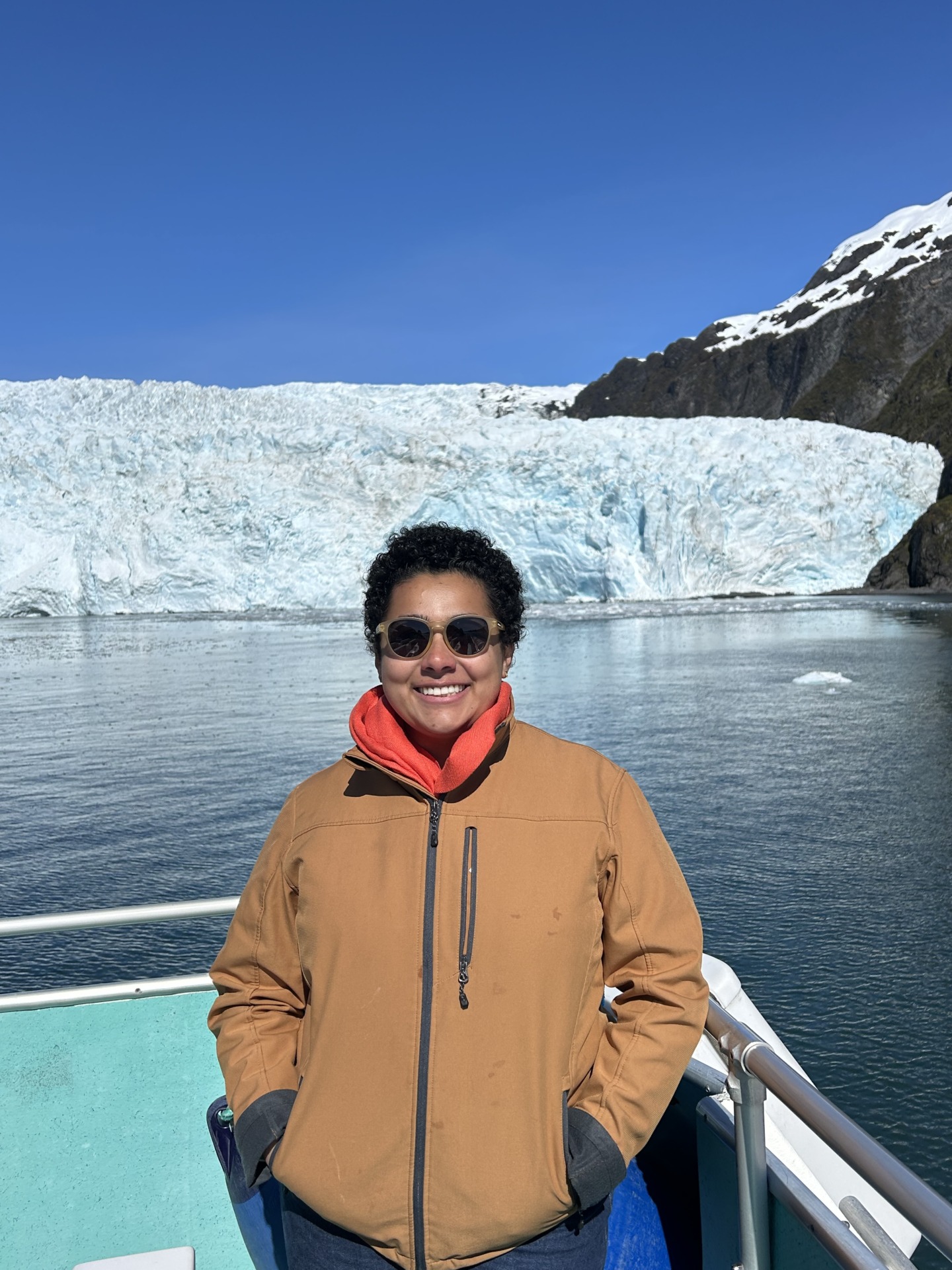
Marian Azeem-Angel stands in front of the Holgate glacier in Alaska. (Submitted photo)
“That was my first experience of like, wow, you can do things and involve and teach people. And my mind was blown. I was like, oh my god, science with the people!” she said.
People — and water — have been the throughlines of Azeem-Angel’s academic career. Now the 2025-2026 J. Philip Keillor Wisconsin Coastal Management Fellow, she’s helping Great Lakes coastal communities build resilience to changing weather and water conditions.
“Coastal things are all new to me, which is very exciting and a lot of learning,” she said.
Her big project is updating the “Coastal Processes Manual,” a guide to help coastal managers and homeowners assess the risks that lake levels, storms, and erosion pose to shoreline property. While there are no oysters in this one, the manual, like the recycling workshops, is focused on meeting the audience’s needs.
“What’s really special about the manual […] is that it’s both a technical document and informational, but it’s also a hands-on working document,” Azeem-Angel said, pointing to worksheets people can use to input details from their own properties. “It’s user-friendly.”
She’s also working with Cailin Young, a fellow Keillor Fellow, to develop chapter summary sheets for coastal resilience workshops Young will lead in the fall. The challenge has been striking the right balance between respecting the audience’s knowledge without assuming they know everything — the crux of science communication.
“I trust that [the audience] will understand it,” she said, “But also, I will do my best to communicate it in a clear way.”
Azeem-Angel is no stranger to that conundrum. A recent graduate of the environment and resources master’s program at the University of Wisconsin–Madison Nelson Institute, her thesis focused on extreme summer rainfall in Madison, social vulnerability, and how city residents perceive flooding risk. The technical nature of her research meant she had to take environmental engineering classes as a non-engineer. Hydrogeology was a formidable opponent, but she said taking the class prepared her to better translate complex science.
“I am here to learn and gain the perspective of engineers,” she said. “Not for me to be one, but for when the time comes that I’m working with them. Hopefully one day I’ll understand what their process is, what their concerns are, what they’re thinking and worrying about, so that I can help the coming-together of the interdisciplinary space, so that we can all understand each other better.”
After the fellowship, Azeem-Angel hopes to continue putting people at the center of her work in an extension or outreach position.
“I can see myself as some kind of bridge person,” she said. “Being a bridge for technical information and bringing that to people so that we can decide how we want to live in a better world.”