
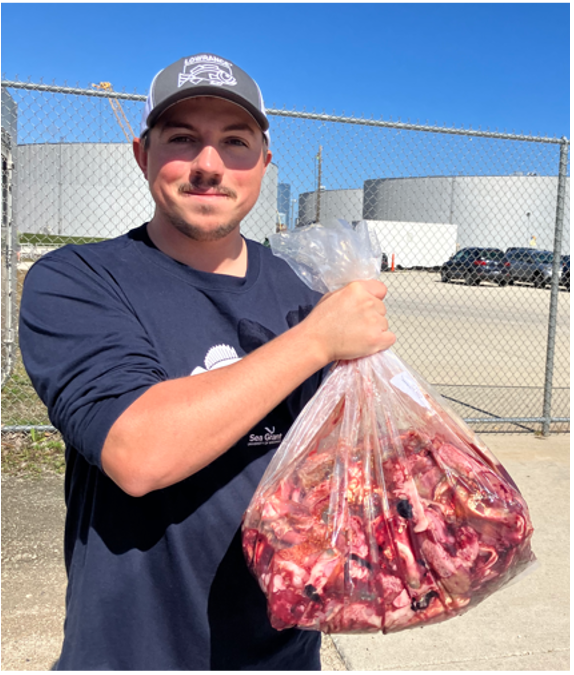
UW–Milwaukee graduate student Kyle Freimuth holding a bag of fish byproducts. Photo: Sharon Moen
When Wisconsin Sea Grant’s Eat Wisconsin Fish team posted the question, “What would you do with a pile of fish guts?,” social media users from across the state creatively responded with ideas that included:
- Make fly traps
- Donate them to the raptor center in Spooner
- Feed them to mink at a mink farm
- And – less helpfully – place them under my brother’s car seat on a sweltering July day
“Fertilizer” was the most popular answer to this post, which was one of several that boosted the 100% Wisconsin Fish Contest. The contest ran from September 16-October 24, 2025. It was part of a broader effort to highlight Wisconsin’s sustainable fisheries and the 100% Great Lakes Fish Initiative, which promotes full use of commercially harvested fish – including byproducts.
Grace Elonen of Omro, Wisconsin, submitted the winning entry. She wrote:
“Fish scales are often the first part discarded when harvesting. Fish scales and skin are comprised of collagen… Knowing the collagen source was sustainably harvested is a good selling point. Knowing the collagen came from our own Great Lakes would be even better. Tagline: Take a little bit of the Great Lakes with you everywhere.”
John Schmidt, program manager for the Conference of the Great Lakes St. Lawrence Seaway Governors and Premiers (GSGP) 100% Great Lakes Fish Initiative, praised the idea. “Collagen from Great Lakes fish scales and skins squarely advances 100% fish goals, has multiple markets, and we’ve already flagged collagen as one of the best-case strategies for the region,” he said.
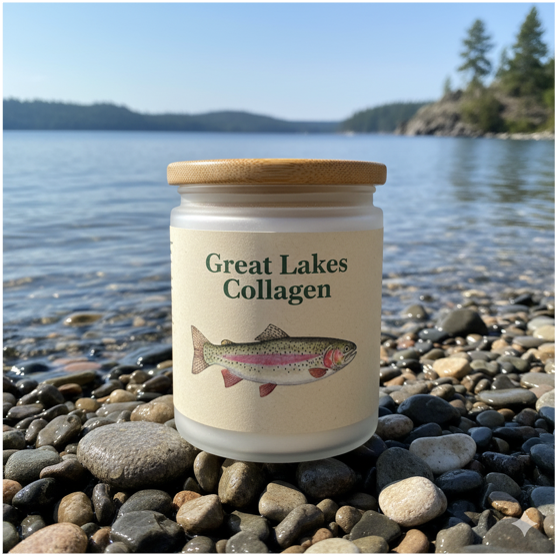
The winning idea for using more parts of a fish involved scales and skin. Photo credit: Gemini AI-generated image submitted by Grace Elonen.
Judges – including Schmidt, two commercial fishers, and a University of Wisconsin-Madison undergraduate – commended Elonen’s regional branding concept, noting that taglines like the one Elonen offered underscore both local pride and market potential.
Charlie Henriksen, co-owner of Henriksen Fisheries and a contest judge, applauded the thoughtfulness behind many submissions. “All the ideas had some value, and I appreciate the people who provided serious replies,” he said.
He gave special mention to making dog treats from dehydrated fish skins and using fish parts for stock. When it comes to fish stock, he said, “The issue to overcome is producing a stock with consistent flavor and texture. Many chowders now use clam juice, so a genuine whitefish stock would be valuable.”
Led by GSGP, the 100% Great Lakes Fish Initiative brings together dozens of partners – including Wisconsin Sea Grant and Wisconsin commercial fishers, fish farmers, and processors – to demonstrate how every part of Great Lakes fish can be used for food, products, and other innovative purposes. Wisconsin Sea Grant’s online contest may serve as a model for similar efforts in other Great Lakes states according to Schmidt.
The contest was made possible through support from GSGP, along with interns Kyle Freimuth and Wyatt Slack, and Wisconsin Sea Grant’s communications team. Special thanks to judges Charlie Henriksen (Henriksen Fisheries), Jessica Resac (Halvorson Fisheries), John Schmidt (GSGP), and UW–Madison undergraduate Wyatt Slack.